

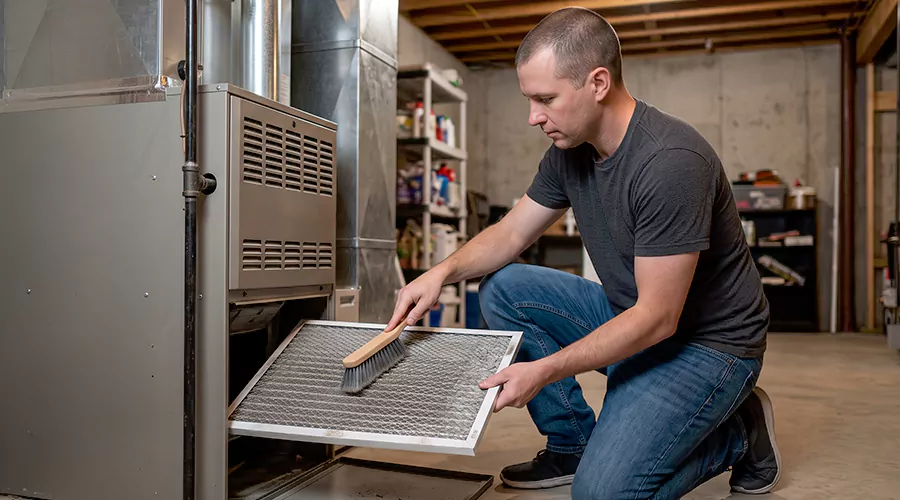
You can clean a washable AC filter by turning off the air conditioner, removing the filter, vacuuming loose dust, and rinsing it with water when the manufacturer permits washing. Allow the filter to dry completely before reinstalling it. Disposable pleated filters, however, should be replaced rather than washed because moisture can damage their filtering material. In such cases, AC air filter replacement is the appropriate solution.
An air conditioner filter helps capture particles from the air moving through the cooling system. Dust and fibers collect on the filter during normal operation, gradually increasing resistance to airflow. If the material becomes heavily clogged, less air may move across the cooling coil and through the room or duct system.
Regular filter maintenance helps the air conditioner operate as designed. A clean filter supports normal airflow and can reduce unnecessary strain on cooling equipment. However, filters are not identical, and the correct cleaning method depends on whether the system uses a washable mesh filter or a disposable filter.
Split AC units and many window air conditioners commonly have washable filters. Central air conditioning systems often use disposable pleated filters that should not be rinsed. Identifying the filter type is therefore the first step before attempting any cleaning.
Why Is Cleaning an AC Filter Important?
An AC filter collects dust and other airborne particles before they reach certain internal components. As deposits accumulate, the filter becomes more restrictive. This can reduce airflow and affect the cooling system's ability to maintain a comfortable indoor temperature.
The U.S. Department of Energy identifies dirty filters as an important cause of reduced air conditioner efficiency. A heavily clogged filter can also contribute to airflow problems that affect the cooling coil. In some cases, inadequate airflow may contribute to coil freezing or poor cooling performance.
Cleaning or replacing the filter can help restore normal airflow when buildup is the actual cause of the restriction. The benefit depends on the condition of the filter and the system. A clean filter cannot repair a refrigerant leak or a failed blower motor.
Regular maintenance also helps identify damaged filter material. A torn mesh or poorly fitted disposable filter may allow particles to bypass the filter and collect on the coil. Checking the filter's condition is just as important as removing visible dust.
How Do You Know if an AC Filter Needs Cleaning?
An AC filter usually needs attention when visible dust covers much of its surface or airflow becomes noticeably restricted. The exact appearance depends on the filter material. A reusable mesh screen may collect a layer of lint and fine dust, while a pleated filter may become discolored as particles accumulate within its folds.
Visible dirt is one reason to inspect the filter, but it should not be the only maintenance trigger. Filters can become restrictive before the entire surface appears heavily coated. Checking them regularly during periods of frequent cooling helps identify buildup early.
Common signs include:
- A thick layer of dust is visible on the filter.
- Airflow from the indoor unit becomes weaker.
- The room takes longer to reach the set temperature.
- Dust accumulates around the indoor air intake.
- The air conditioner operates longer than expected.
- The filter has not been checked for several weeks during heavy use.
- The filter mesh appears blocked by fibers or pet hair.
- Cooling performance improves after an overdue filter replacement.
- The indoor coil shows signs of airflow-related freezing.
- The filter is visibly torn or no longer fits securely.
These conditions do not all prove that filter cleaning will solve the problem. Weak cooling can also involve dirty coils or other equipment issues. However, the filter is a reasonable first component to inspect because it is often accessible without opening mechanical service panels.
Can You Wash Every AC Filter?
No. Only filters specifically designed and labeled as washable should be rinsed with water. Many reusable filters found in wall-mounted split units can be washed, but standard disposable pleated filters generally cannot. Specialized deodorizing and high-efficiency filters may also require replacement or a different maintenance method.
| AC Filter Type | Can It Be Washed? | Recommended Maintenance |
|---|---|---|
| Reusable nylon or plastic mesh filter | Usually yes | Vacuum or rinse as instructed |
| Washable window AC filter | Usually yes | Clean and dry completely |
| Washable mini-split pre-filter | Usually yes | Vacuum, then wash when necessary |
| Standard disposable pleated filter | No | Replace with correct filter |
| Disposable fiberglass filter | No | Replace |
| High-efficiency disposable media filter | Usually no | Follow manufacturer replacement schedule |
| Activated carbon or deodorizing filter | Depends on design | Follow specific instructions |
| Specialized air-purification filter | Depends on product | Use model-specific maintenance method |
Never assume that a filter is washable simply because it looks like plastic or can be removed easily. Some air conditioners contain multiple layers with different maintenance requirements. The mesh pre-filter may be washable while a separate deodorizing element must stay dry.
If the filter's instructions are unavailable, check the model information before applying water. Washing an unsuitable filter can reduce its performance or permanently damage the media.
What Tools Do You Need to Clean an AC Filter?
Most washable AC filters can be cleaned with basic household supplies. The goal is to remove dust gently without stretching the mesh or damaging its frame. Strong chemicals and rough brushes are generally unnecessary.
Gather these items before starting:
- Vacuum cleaner with a soft brush attachment
- Soft-bristled cleaning brush
- Clean, cool or lukewarm water
- Mild liquid detergent, if approved
- Clean microfiber cloth
- Suitable container or sink
- Dry, shaded area with good ventilation
- Air conditioner manufacturer's instructions
Do not use boiling water or aggressive solvents. Some filter frames and mesh materials can deform when exposed to high temperatures. Sharp tools can also tear the mesh and make the filter unsuitable for continued use.
Daikin and LG both recommend gentle cleaning methods for many washable split AC filters. They advise drying washed filters in a shaded, ventilated area before reinstalling them.
How to Clean an AC Filter Step by Step?
The cleaning procedure below applies to an AC filter that the manufacturer identifies as washable. It is suitable for many split AC, window AC, and portable AC mesh filters. Central HVAC systems using disposable pleated filters require replacement rather than this washing procedure.
Step 1. Turn Off the Air Conditioner
Switch off the air conditioner and wait until the fan stops. For a plug-in window or portable unit, disconnect electrical power according to the manufacturer's instructions before opening the filter compartment. This prevents the appliance from starting while the filter is being handled.
Wall-mounted split systems may have a designated power isolator or circuit breaker. Follow the equipment instructions for safe filter access. Do not open electrical service panels or touch wiring during routine filter maintenance.
The filter should be removed only from the user-accessible compartment. Internal coil and blower cleaning require different procedures and may need a qualified technician.
Step 2. Locate the Filter Compartment
Identify where the air conditioner draws air into the indoor unit. On many wall-mounted split ACs, the filters sit behind the front intake panel. Window and portable units often have filters behind a front or rear grille.
Central AC filters may be located inside a return grille or a designated filter cabinet near the air handler. The exact position varies by installation. Consult the model's manual if the location is uncertain.
Do not confuse an outdoor condenser coil with a filter compartment. The outdoor unit normally does not contain the ordinary indoor return-air filter used for household particle filtration.
Step 3. Open the Access Panel Carefully
Release the access cover using the method specified for the unit. Some split AC panels lift upward, while others use small retaining clips. Window and portable units may have a sliding filter frame or removable intake grille.
Avoid forcing plastic clips because they can become brittle with age. Support the panel while opening it so its hinges are not overloaded. If the cover does not move as expected, consult the model instructions instead of pulling harder.
The filter should be visible once the designated access panel is open. Do not remove additional covers unnecessarily.
Step 4. Remove the Filter
Grip the filter by its frame and slide or lift it out gently. A heavily dusty screen may release loose particles during removal. Keep the dirty side facing upward or away from surrounding furnishings when practical.
Look at how the filter was installed before removing it completely. Some units contain two mesh filters that fit into separate guides. Taking a photograph can make reinstallation easier.
Avoid pulling on the mesh itself because it may stretch or tear. A damaged filter can allow dust to pass through openings that were not part of its original design.
Step 5. Inspect the Filter Material
Check the filter for cracks, holes, broken supports, and damaged edges. If the filter is disposable, do not proceed with washing. Replace it with the correct size and type recommended by the manufacturer.
For a washable mesh filter, identify whether the dust is mostly loose or attached to the material. Light deposits may come off with vacuuming alone. Heavy buildup may require rinsing and gentle washing.
If the filter has separate deodorizing or air-purification elements, check their instructions individually. Some should be removed before the washable mesh is cleaned.
Step 6. Vacuum Loose Dust
Use a vacuum with a soft brush attachment to collect dust from the filter. Move gently across the surface without pressing hard against the mesh. Vacuuming first reduces the amount of material that enters the sink when washing becomes necessary.
Hold the filter securely so suction does not bend its frame. Avoid using a narrow high-suction nozzle that pulls delicate mesh out of shape. A soft brush can help loosen fibers around the edges.
For a lightly dirty filter, vacuuming may be sufficient if the manufacturer permits dry cleaning. More substantial buildup can require rinsing.
Step 7. Rinse the Washable Filter
Use cool or lukewarm running water to rinse a filter that is approved for washing. Guide the water gently through the mesh to remove remaining dust. Avoid strong jets that could stretch the material or deform its frame.
Daikin and LG advise avoiding hot water above approximately 40°C for certain washable air conditioner filters. The exact limit depends on the product, so the manufacturer's instructions should take precedence.
Do not place the filter in a dishwasher or washing machine unless it is specifically designed for that method. Mechanical agitation can damage a filter that is intended only for hand cleaning.
Step 8. Use Mild Detergent if Needed
When dust or grime remains after rinsing, apply a small amount of mild detergent if the manufacturer permits it. Gently clean the mesh with a soft cloth or brush. Avoid scrubbing so hard that the openings become stretched or distorted.
Harsh chemicals and strong fragrances are unnecessary for ordinary filter dirt. Bleach and solvent-based cleaners may damage the frame or mesh. They may also leave residues that are unsuitable for the filter's intended use.
Cleaning should remove the deposits without altering the filter material. A screen that has become brittle or damaged may require replacement rather than more aggressive washing.
Step 9. Rinse Away Soap Residue
Rinse the filter gently with clean water until the detergent is removed. Residual soap can leave a film on the mesh and may interfere with normal airflow. Make sure that material trapped near the frame edges has also been removed.
Check both sides of the filter for remaining deposits. A small amount of discoloration may persist even when the mesh is clean. The aim is to restore the open filter passages, not to bleach the material back to a perfectly new appearance.
Allow excess water to drain without twisting the filter. Twisting can deform the frame and affect its fit.
Step 10. Dry the Filter Completely
Place the washed filter in a shaded, well-ventilated area and allow it to air-dry completely. Drying time depends on humidity and the filter's construction. Do not reinstall the filter while water remains trapped in the mesh or frame.
Avoid placing the filter directly under strong sunlight or near an open flame. Excessive heat may distort plastic material. A hair dryer or other concentrated heat source can also damage the mesh.
Manufacturer guidance from Daikin and LG recommends shaded drying for many washable filters. The filter should be completely dry before it is placed back inside the unit.
Step 11. Reinstall the Clean Filter
Return the filter to its original guides or retaining clips. It should fit securely without bending or leaving gaps around its frame. If the system has two filters, install each in the correct position.
For central air conditioning filters, follow the airflow-direction marking on the frame when applicable. The arrow should point in the direction specified by the filter housing and air-moving equipment. An incorrectly installed filter may not fit or perform as intended.
Close the access panel securely. A panel left partly open can affect airflow or create rattling during operation.
Step 12. Restore Power and Test the AC
Restore power and operate the air conditioner normally after confirming that the filter is dry and correctly installed. Check that air moves through the indoor unit without unusual noise. A clogged filter that was restricting airflow may produce a noticeable improvement after cleaning.
If cooling remains weak, other components may require attention. The evaporator coil could contain significant deposits, or the system may have a mechanical problem. Repeatedly cleaning an already clean filter will not correct those conditions.
Record the cleaning date so you can monitor how quickly the filter becomes dirty during normal use.
How to Clean a Split AC Filter?
Wall-mounted split air conditioners commonly contain reusable mesh filters behind their front intake panels. These filters are generally intended for frequent cleaning because they collect particles directly from room air. Many models allow the filter to be removed without tools.
Turn off the unit and open the designated front panel according to its instructions. Remove the mesh filters carefully and vacuum loose dust from their surfaces. If washing is permitted, rinse with lukewarm water and use a small amount of mild detergent when necessary.
Allow the filters to dry fully in a shaded area before reinstalling them. Daikin recommends cleaning many split AC filters approximately once every two weeks during normal use. Dusty environments and frequent operation may require more attention.
Some split systems include separate deodorizing or fine-particle filters that cannot be washed. These elements should be maintained according to their own instructions rather than treated like the mesh pre-filter.
How to Clean a Window AC Filter?
Window air conditioners commonly use an accessible filter behind the front grille. Many models have washable screens, although the exact design varies. The filter should be inspected regularly because a small indoor unit can experience noticeable airflow restriction when its screen becomes heavily loaded.
Turn off and unplug the unit before removing the filter. Open the access panel and slide out the screen according to the manufacturer's directions. Vacuum loose dust and wash the filter only if it is designed for rinsing.
After cleaning, let the filter dry completely before returning it to the grille. Reinstall the cover and check that the intake passage is not blocked. A clean filter helps maintain airflow, but it does not replace cleaning a dirty cooling coil when that component needs professional attention.
If water repeatedly collects in the wrong area of a window unit, investigate drainage and installation conditions separately. Filter washing will not correct a blocked condensate passage.
How to Clean a Central AC Filter?
Central air conditioning systems commonly use disposable pleated filters. These filters should generally be replaced rather than washed because water can damage their media. The filter may be located at a return grille or in a cabinet connected to the air handler.
Turn off the system before removing the filter. Check its dimensions and the manufacturer's recommended specifications. Remove the old filter carefully and install a replacement of the appropriate type, making sure it fits securely.
If the central system has a filter specifically labeled as washable, follow its approved cleaning method. Rinse only if permitted and allow the material to dry completely before reinstalling it. A reusable central filter should not be treated as washable merely because it has a rigid frame.
Check that the filter housing is closed correctly after replacement. Gaps around a filter can allow dust to bypass the material and enter the coil or blower assembly.
How to Clean a Portable AC Filter?
Portable air conditioners often contain one or more filters behind an intake grille on the unit. Some models use a washable mesh screen that can be removed by sliding it out of the designated compartment. Other models include additional air-purification elements with different maintenance requirements.
Unplug the unit and remove the filter according to its manual. Vacuum or gently brush away loose dust. Wash only the elements identified as washable, using mild detergent if approved.
Allow washed components to dry in a ventilated area away from direct heat. Reinstall every filter in its original position before turning the unit back on. A missing or poorly fitted screen may allow more dust to enter the equipment.
Portable AC filters are separate from the unit's condensate drainage system. If the appliance displays a water-full warning or leaks, the drainage arrangement should be checked separately.
How Often Should You Clean an AC Filter?
Cleaning frequency depends on the filter type and how often the air conditioner operates. Many wall-mounted split AC manufacturers recommend checking or cleaning washable mesh filters approximately every two weeks. Central HVAC filters are commonly inspected monthly during heavy use and replaced according to their condition and manufacturer instructions.
| AC System or Filter | Practical Maintenance Interval |
|---|---|
| Wall-mounted split AC washable mesh | Check or clean about every two weeks during frequent use |
| Window AC washable filter | Inspect regularly and clean as directed |
| Portable AC washable filter | Inspect during regular use and clean as needed |
| Central AC disposable filter | Check monthly and replace when required |
| Washable central HVAC filter | Inspect monthly and clean according to instructions |
| Special deodorizing or purification filter | Follow the model-specific schedule |
These intervals are starting points rather than fixed rules for every household. A home near a dusty road or undergoing renovation may accumulate particles more quickly. Homes with pets or frequent air conditioner use may also need more regular attention.
A filter that becomes unusually dirty soon after cleaning may indicate heavy dust exposure or an issue with the air intake environment. Frequent cleaning can help maintain airflow, but the source of excessive dust may also deserve attention.
What Happens if You Do Not Clean an AC Filter?
A neglected AC filter becomes increasingly restrictive as dust collects across its surface. The blower may have difficulty moving the intended amount of air through the equipment. This can contribute to longer cooling cycles and reduced comfort.
In some systems, low airflow across the evaporator coil may contribute to freezing. When ice forms, cooling performance can deteriorate further. A dirty filter is only one possible cause, so repeated freezing requires qualified diagnosis.
Particles may also collect inside the equipment when the filter is damaged or poorly fitted. Deposits on the coil or blower require more involved cleaning than ordinary filter maintenance. Keeping the filter in suitable condition helps reduce avoidable buildup.
A dirty filter does not automatically mean that every supply duct requires cleaning. The filter and duct system perform different functions. Maintaining one component should not be used as a reason to purchase unrelated cleaning services without evidence.
Can You Clean an AC Filter With Water Only?
Yes, many washable mesh AC filters can be cleaned using water alone. Vacuuming first removes loose dust, while gentle rinsing helps clear particles trapped in the mesh. Mild detergent may be useful when the filter contains sticky deposits and the manufacturer permits it.
However, water should never be applied to disposable pleated filters unless the product is specifically designed for washing. Paper-like filter media can lose its shape or filtering properties after becoming wet. Specialized filters may also have coatings or materials that require dry cleaning or replacement.
The safest approach is to identify the filter type first. A washable designation and manufacturer instructions provide a better basis than appearance alone.
Can You Put a Wet AC Filter Back Into the Unit?
A washable AC filter should be completely dry before it is reinstalled. Moisture remaining in the mesh or frame may affect the surrounding equipment and can contribute to unwanted dampness. Manufacturers commonly recommend air-drying in a shaded, ventilated location.
Do not try to speed drying with a heat gun or very hot hair dryer. High temperatures can distort plastic frames and damage the filter material. Allow enough drying time for the filter to return to its normal dry condition.
If the filter still feels damp, wait before reinstalling it. Running the air conditioner without its required filter is not an appropriate alternative.
What Mistakes Should You Avoid When Cleaning an AC Filter?
Improper cleaning can damage the filter or create an airflow problem that was not present before. The most common mistake is washing a disposable filter. Another is reinstalling a washable screen before it has dried completely.
Avoid these mistakes:
- Washing a disposable pleated filter.
- Using water on a filter labeled non-washable.
- Cleaning the filter while the AC is operating.
- Pulling the filter by its delicate mesh.
- Scrubbing with a stiff wire brush.
- Using boiling or excessively hot water.
- Applying bleach or strong solvents.
- Leaving detergent residue in the mesh.
- Drying the filter with excessive heat.
- Reinstalling the filter while damp.
- Installing the filter backward or outside its guides.
- Operating the unit without its required filter.
- Mixing up washable and non-washable filter layers.
- Ignoring a torn or damaged filter frame.
A filter that has lost its shape may no longer fit securely. Cleaning it repeatedly cannot repair broken mesh or a damaged frame. Replacing the affected filter is usually more appropriate.
Can Cleaning the AC Filter Improve Cooling?
Cleaning a clogged AC filter can improve cooling performance when restricted airflow was contributing to the problem. Removing deposits allows more air to pass through the intended filter area. The system may then circulate conditioned air more effectively.
However, the improvement depends on the condition of the air conditioner. A dirty evaporator coil or malfunctioning fan can continue restricting airflow even after the filter has been cleaned. Refrigerant or control problems also require separate diagnosis.
If cooling remains poor, check whether the filter was correctly reinstalled and the intake grille is unobstructed. Persistent freezing, unusual noise, or water leakage should be evaluated by a qualified technician.
When Should You Replace an AC Filter Instead of Cleaning It?
Replace a filter when it is disposable or physically damaged. Torn mesh and cracked frames can allow particles to bypass the filter, while some specialized media lose effectiveness after their recommended service period. A filter should also be replaced when the manufacturer specifies a replacement schedule rather than washing.
A reusable filter may eventually wear out after repeated cleaning. Look for stretched mesh or edges that no longer fit securely. If the material cannot be restored through the approved cleaning process, replacement is more appropriate.
Use a compatible replacement designed for the air conditioner model. The wrong dimensions or airflow characteristics can create new problems. Manufacturer guidance should determine the appropriate product.
How Can You Keep AC Filters Cleaner for Longer?
Ordinary household dust cannot be eliminated completely, but regular housekeeping can help reduce excessive filter buildup. Vacuuming floors and furnishings removes particles before they become airborne and reach the intake. Keeping return grilles clear also supports normal airflow.
Avoid blocking the indoor AC intake with curtains or furniture. An obstructed intake can reduce airflow even when the filter is clean. During dusty renovation work, protect the equipment as appropriate and avoid operating it while large amounts of debris are airborne when practical.
Keep a simple maintenance record. The time between cleanings can reveal whether the household's dust conditions are changing. Consistent filter care is more useful than allowing buildup to become severe and then attempting aggressive cleaning.
Conclusion
Cleaning an AC filter is a simple maintenance task when the filter is designed to be washable. Turn off the air conditioner, remove the screen, clear loose dust, rinse it gently when permitted, and let it dry completely before reinstalling it. Disposable pleated filters should be replaced rather than washed. Regular filter maintenance helps maintain airflow and reduce unnecessary strain on the cooling system. Start by identifying your filter type and following the cleaning schedule recommended for your AC model.